
Criminal Court Cases in Upson County
Upson County uses several courts, and jurisdiction determines where a file lives. Superior Court hears felonies as part of the four-county Griffin Judicial Circuit. Magistrate Court issues warrants, conducts first appearances, considers bond when authorized, and hears matters within its limited criminal power. Probate Court handles locally assigned traffic cases. Thomaston Municipal Court keeps city ordinance, traffic, and other matters within municipal jurisdiction. Juvenile Court records are generally confidential and should not be treated like public adult dockets.
The Clerk of Superior Court maintains the filed Superior Court record. That file can include the charging paper, docket entries, motions, orders, plea or verdict, judgment, and sentence. Lower courts keep their own records until a matter moves to Superior Court. A reader who knows only that an arrest occurred should first identify the charging court rather than assume every Upson County case is in the felony clerk system.
Which Upson County Court Has the File?
The best search channel follows the type and stage of the case. A warrant or first appearance may begin in Magistrate Court, yet the later felony prosecution belongs in Superior Court. Probate and municipal records can remain outside the Superior Court index. The offices now operate within, or connect to, the county's consolidated Justice Center, but their record sets remain distinct.
| Court | Criminal role | Contact |
|---|---|---|
| Superior Court Clerk | Felony cases and filed Superior Court records | 706-647-5847 |
| Magistrate Court | Warrants, first appearances, bond, limited offenses | 706-647-6891 |
| Probate Court | Locally assigned traffic matters | 706-647-7015 |
| Juvenile Court | Confidential juvenile proceedings | 706-647-0028 |
The official Upson Magistrate Court page helps confirm the limited court's role. Its public page is shown below, and that division should be contacted when a warrant or first-appearance record has not yet become a Superior Court case.
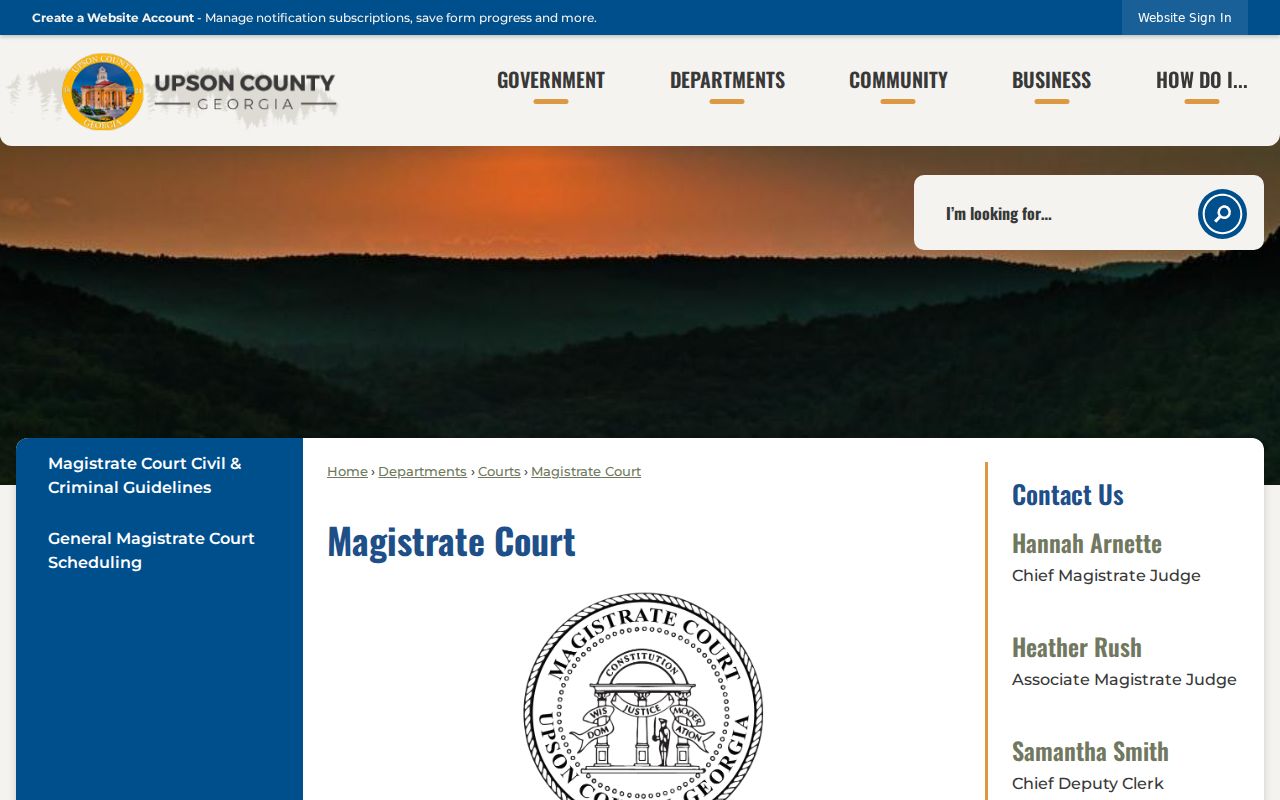
The image reinforces a key search rule: use the court that created the event before looking for a later felony docket.
Upson County Case Record Searches
Start with the county-linked Criminal/Civil Search. A case number is the strongest key. When it is unknown, search a carefully verified name and narrow by the criminal record type or date range when those controls appear. The vendor interface can change, and an online result is not a certified judgment. Use the clerk counter, mail, or phone channel when a file is older, unavailable, or incomplete online.
- Open the clerk search and choose the criminal division or record type when offered.
- Enter the full Upson County case number, or use a party name with careful identity checks.
- Narrow results by filing year, event range, or case type instead of relying on a common name alone.
- Open the docket and distinguish scheduled events from filed orders and final dispositions.
- Ask the clerk for a plain or certified copy when the actual judgment, sentence, or disposition is needed.
| Field Label | Type | Required | Notes |
|---|---|---|---|
| Last Name | Text | Mode-dependent | Primary name field; verify identity |
| First Name | Text | Optional | Narrows common surnames |
| Case Number | Text | Mode-dependent | Calendars show formats such as 20R0316U |
| Record Type | Select | Optional | Choose criminal when available |
| Date Range | Date fields | Optional | Narrows filing or event dates |
What Upson Criminal Calendars Show
The county's criminal calendar archive is a second official access channel. Current PDFs can show the court, calendar type, judge, hearing date and time, courtroom, local case number, party styling, count, charge description, alleged offense date, prosecutor, defense counsel, and event note. Those details can help identify a case when the main portal is unavailable.
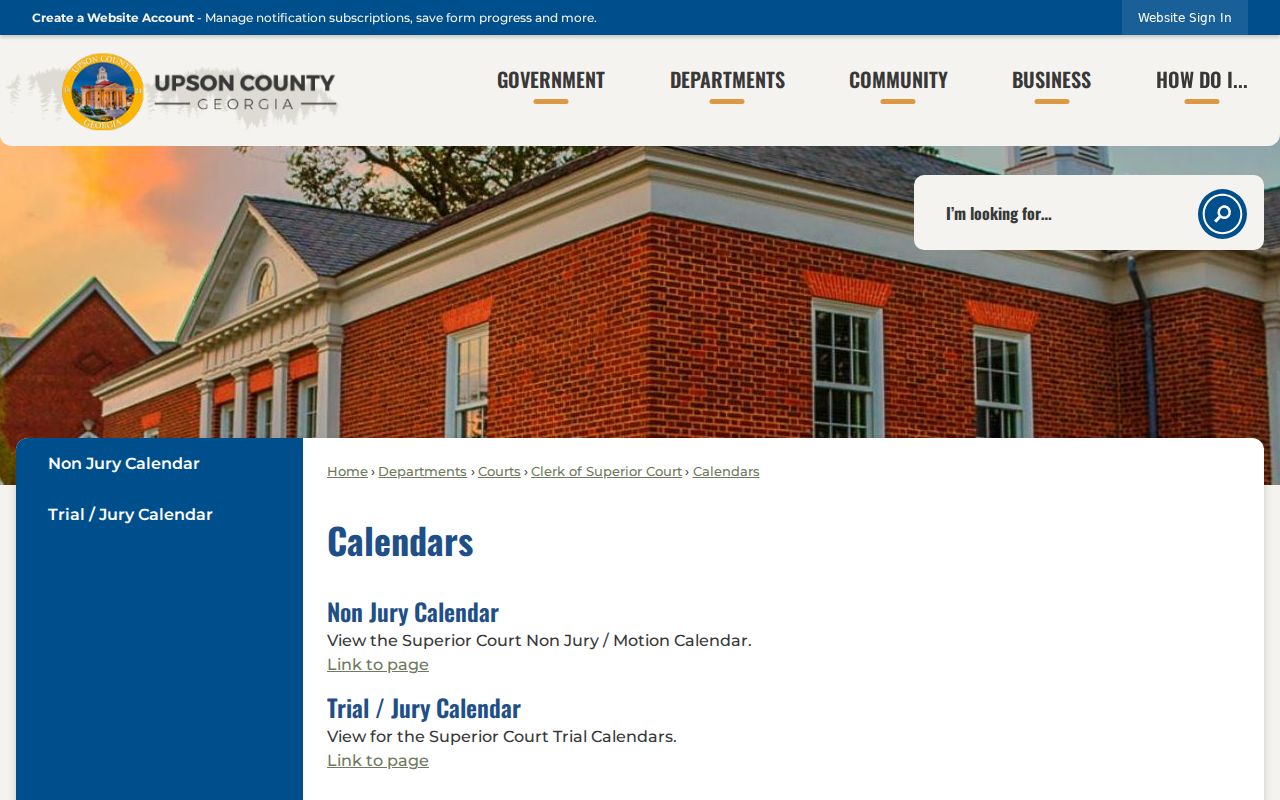
The calendar view provides document-level context, but it is not a complete docket and does not prove that a listed hearing occurred.
What a Criminal Case File Contains
A complete Upson County case file is richer than a calendar or booking record. The charging document states the counts prosecutors filed. Docket entries trace activity. Orders, pleas, verdicts, judgments, and sentences establish what the court actually decided. Financial entries may show fines, fees, or restitution, while access to protected details can be limited. Request the precise document needed instead of asking the clerk to create a new case summary.
| Case Number & Court | Identifies the file and the court with jurisdiction. |
|---|---|
| Charging Document | An accusation or indictment states the filed counts. |
| Docket Entries | Chronological filings, hearings, motions, and orders. |
| Hearing Dates | Scheduled or completed court events, subject to change. |
| Disposition & Judgment | The outcome for each count, such as dismissal, plea, acquittal, or conviction. |
| Sentence & Conditions | Court-ordered custody, probation, fines, or other terms. |
Certified Upson Judgments at Highway 19
When proof matters, contact the clerk at the Upson County Justice Center, 1185 Highway 19 South in Thomaston. The main-floor office is open Monday through Friday, 8:00 a.m. to 5:00 p.m., and can be reached at 706-647-5847. Its mailing address is P.O. Box 469, Thomaston, GA 30286. Give the case number, court, party name, and the exact item requested. No current official criminal copy-price schedule was verified, so ask about search, copy, and certification costs before ordering.
The Justice Center also consolidates prosecution and defense functions. The Griffin Circuit district attorney page illustrates the felony charging role.
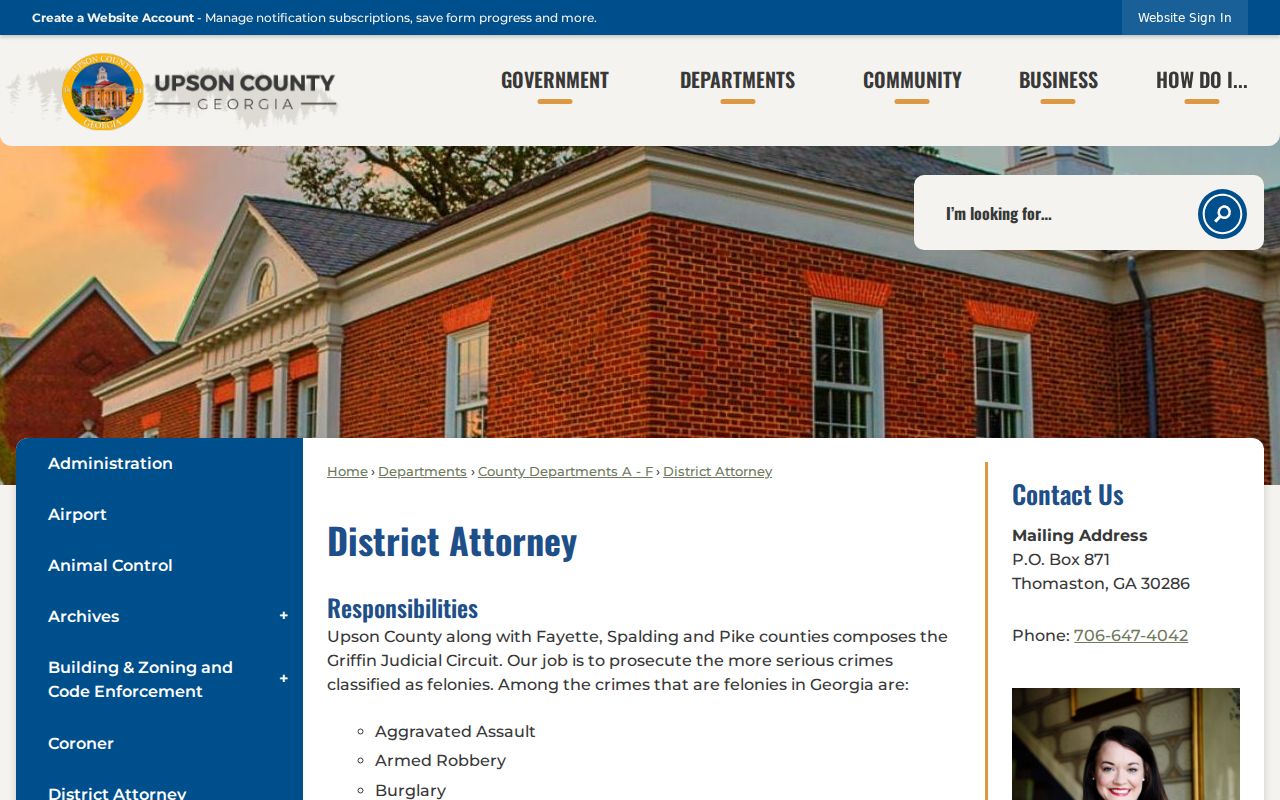
Prosecutors create accusations and handle charges, but filed court documents and certified judgments remain clerk records.
The Upson public defender directory shows the defense office serving the same circuit.
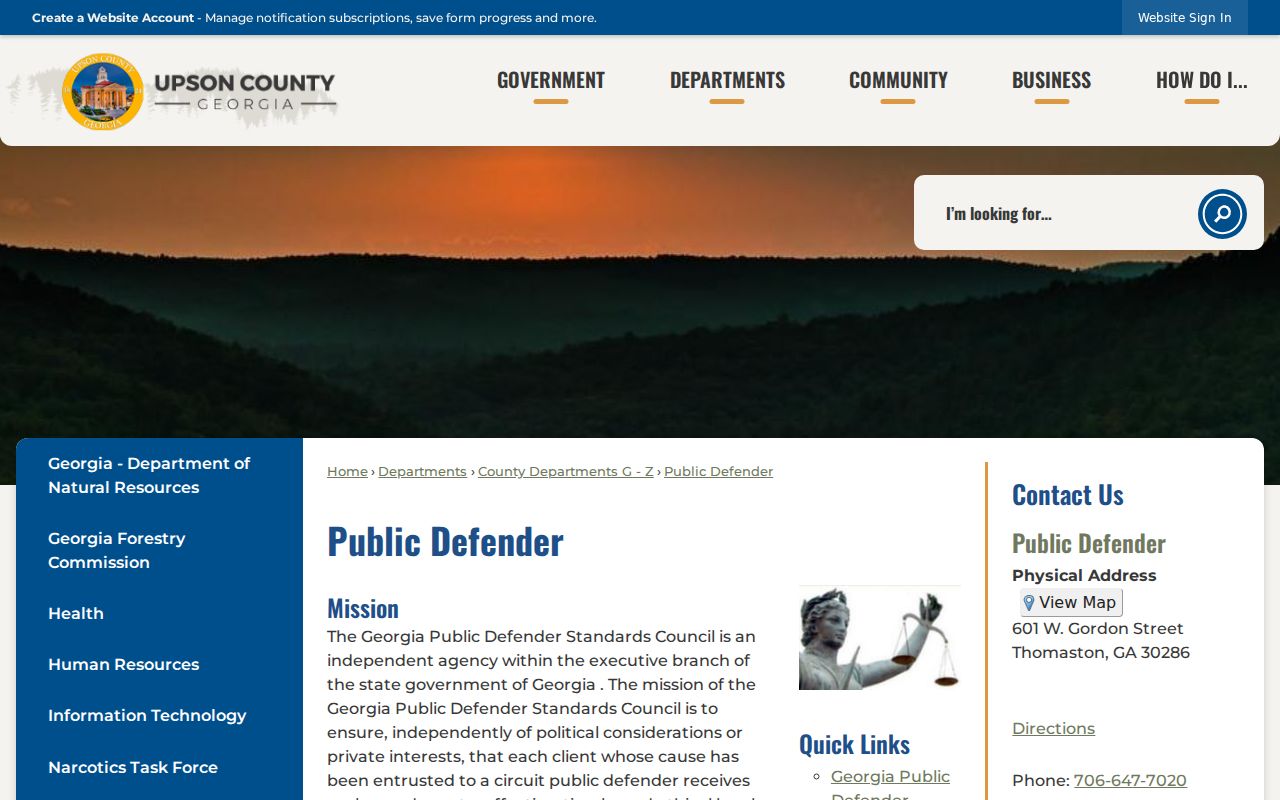
Because county pages have shown conflicting defender addresses during the Justice Center transition, call 706-647-7020 before an in-person visit.
Criminal Case Stages in Upson County
A felony matter may start with an arrest or warrant, followed by first appearance and bond. Prosecutors then decide whether to file an accusation or seek a grand-jury indictment. Arraignment is the formal stage at which the accused answers the charge. Discovery, motions, plea talks, or trial follow. The court then records a judgment and sentence. Post-trial motions and appeals can add later entries. No fixed local time applies to every case, so docket events are safer than estimates.
Case flow: Charges Filed › Arraignment › Pretrial › Plea or Trial › Disposition › Sentencing
- Accusation
- A prosecutor's charging document used without indictment where Georgia law permits.
- Indictment
- A felony charging document returned by a grand jury.
- No-bill
- A grand jury decision not to return an indictment.
- Nolle prosequi
- A formal decision by the prosecutor not to continue a charge.
PeachCourt and Upson Electronic Records
Upson County's PeachCourt explanation describes the statewide e-filing service used by participating clerks. PeachCourt can provide an electronic route for certain records, but Georgia has no single comprehensive free criminal docket covering every trial court. Treat it as one channel beside the local clerk portal, calendar PDFs, and clerk counter.
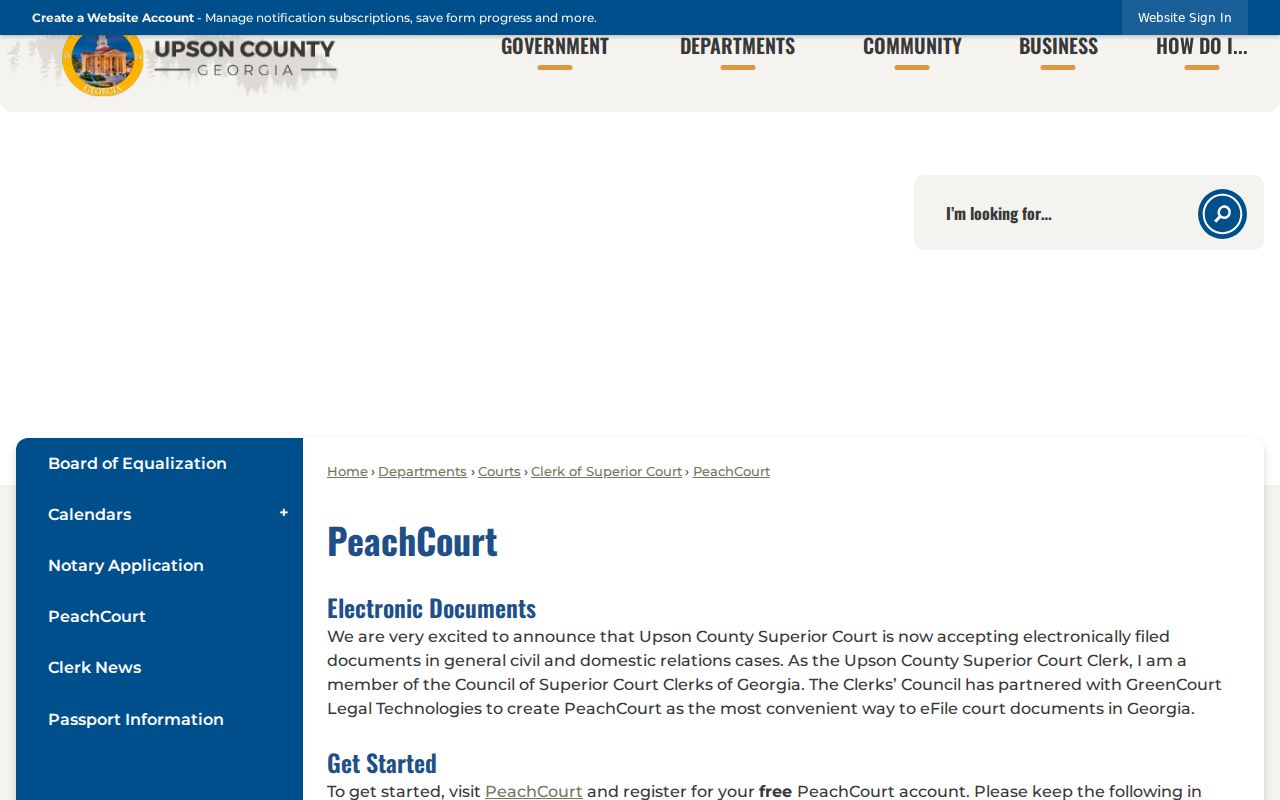
The image shows why county-specific verification still matters: participation and available documents can vary by court and case.
When an Older Upson File Is Missing
An older Upson County court case may not appear in the current vendor index. Call the clerk with the party name, approximate year, court, and any case-number fragment. Ask whether the file is stored off-line and whether inspection, a plain copy, or a certified copy can be arranged by counter or mail. The clerk is also the right source when a calendar identifies a matter but the portal does not expose its docket.
For historic research, the Thomaston-Upson Archives holdings include court dockets reaching back to the county's 1824 beginnings. Archive material has a different purpose from a current certified judgment, so confirm which office can supply the record needed.
Access Rules for Case Records
Georgia court files are generally open, but that rule has limits. Juvenile files, sealed matters, protected victim information, security-sensitive records, and other material shielded by law may be unavailable or redacted. An online system may display less than the courthouse file. Absence from a name search can also reflect spelling, indexing, case age, or a vendor outage rather than proof that no case exists.
The Georgia Open Records Act guidance explains access to agency records, while O.C.G.A. §15-6-61 assigns Superior Court recordkeeping duties to the clerk. Ask for an existing docket, order, or judgment. The Act does not require staff to create a new analysis. Older Upson files can also lead to the Thomaston-Upson Archives, whose holdings include historic court dockets dating to 1824.
The Probate Court page is a separate official route for qualifying traffic records.
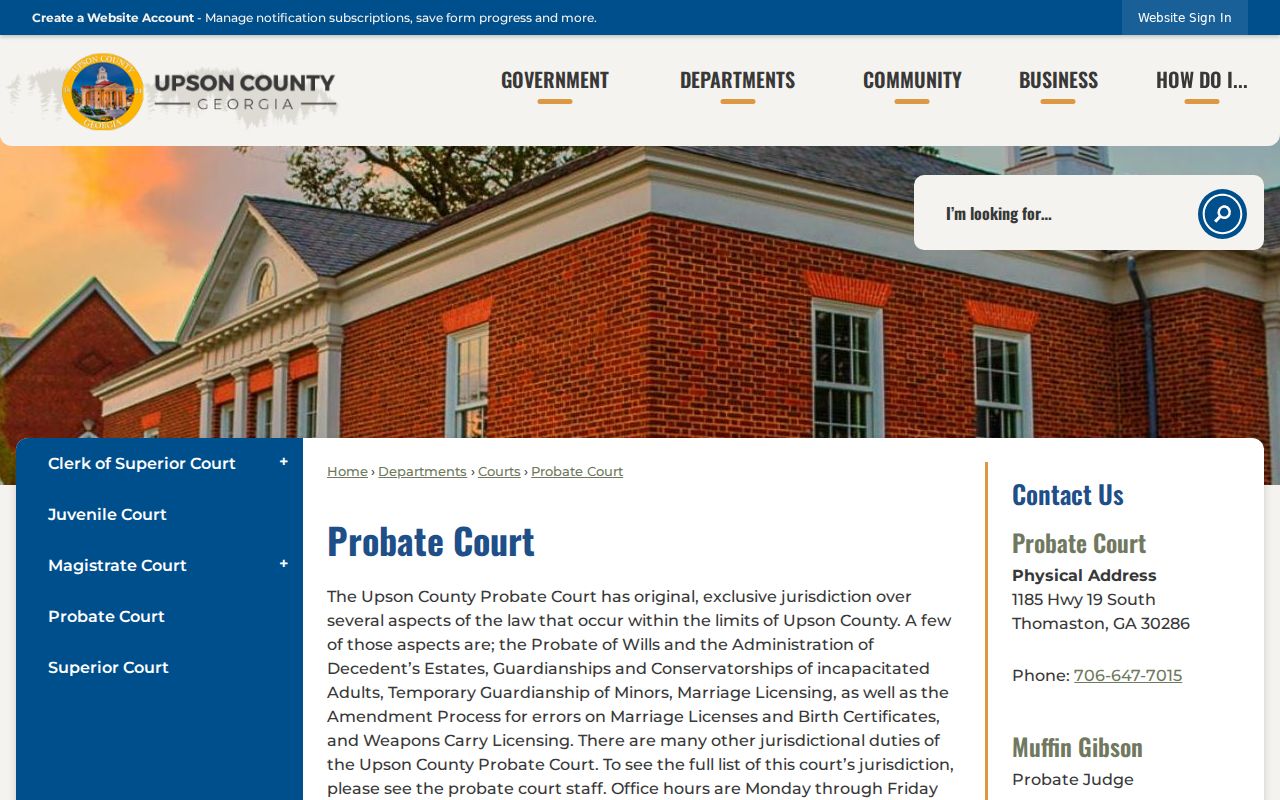
That court-specific source helps prevent a traffic record from being mistaken for a Superior Court felony file.